
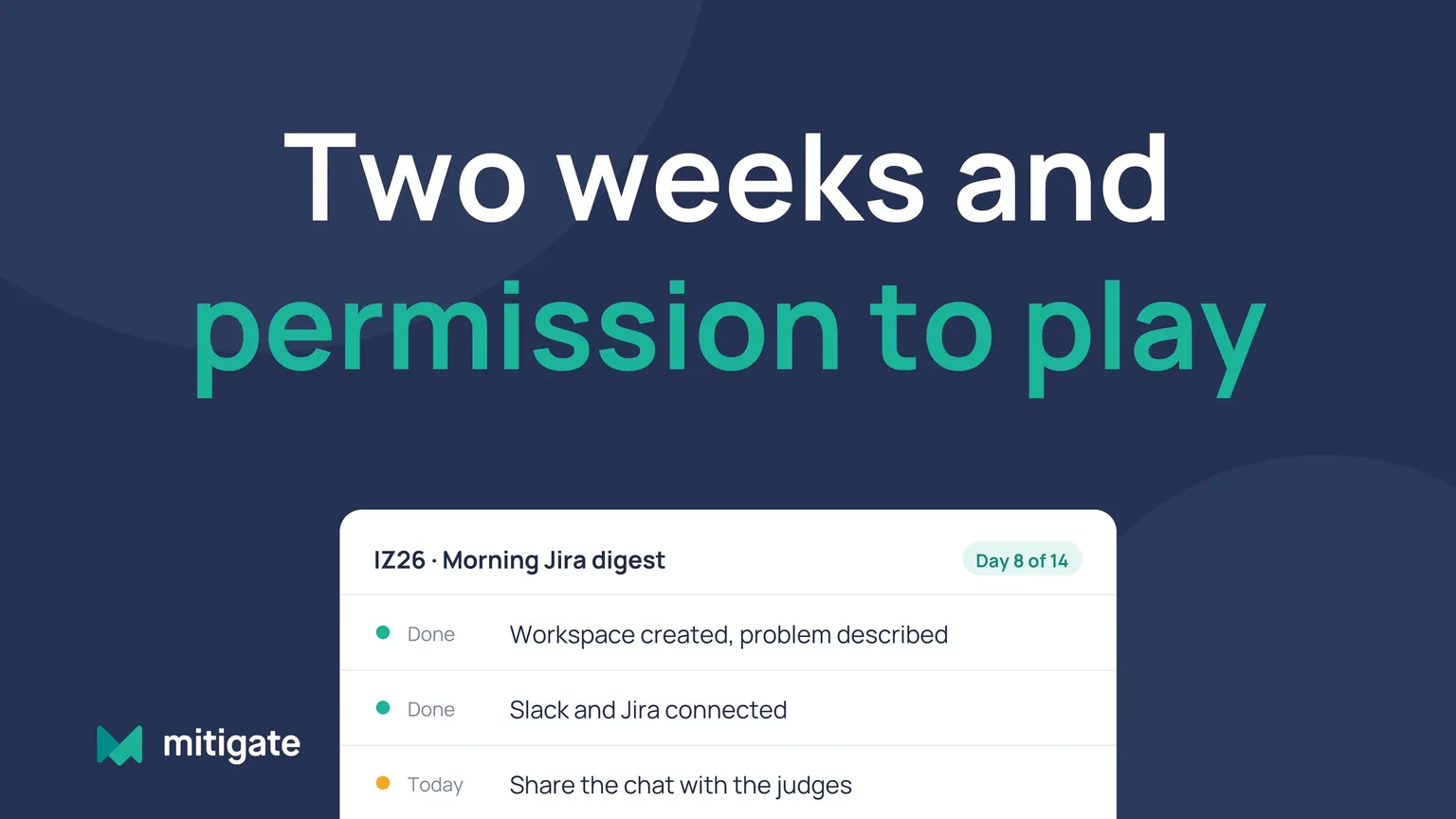

When someone in a company asks "when are we going to roll out AI", the usual answer is a strategy, a working group and a quarter. We tried a different answer: two weeks, one safe environment and a rule that everyone takes part. This post is about what an internal AI challenge looks like, what we expect from it and why the first step in change management is not a plan but play.
Why play, not training
The biggest barrier to a new technology is not a lack of knowledge. It is the fear of breaking something. In a training session you watch someone else work. When you play, you do the work yourself, on your own problem, and you are allowed to get it wrong. That is why everyone on our Mitigate AI platform has their own workspace with a sandbox: whatever you do there stays there. You can connect Gmail, Slack, Jira or Harvest, write a skill, put together a workflow and see what happens. If it does not work, nothing is lost except an hour.
We put the same principle into the rules of the challenge. You do not have to build something big. You do have to start.
The rules on one page
The challenge runs for two weeks, from 30 September to 14 October. Everyone in the company takes part. Everyone here already uses AI, but developers usually do it in code, and this time they do it on the platform too. Each person creates a workspace named in one format, "IZ26 - First name Last name - idea", and writes in the description which problem it solves. The submission is the workspace itself: the description, a shared chat and, if there is one, a workflow with a video or screenshots so the judges can see it working. A small jury from management and the platform team does the judging. The prize is 1,000 EUR, but the real gain is something else, more on that below.
One problem is enough, one that annoys you personally. If you solve it for yourself, we will find someone else to solve it for.
What we judge
Not the prettiest presentation. We look at four things. Is the problem real, that is, does someone actually do this by hand every day. Does the solution work, rather than just being described. Can someone other than the author use it. And has the author understood where the AI gets it wrong, because the person who knows the limits of their tool is ready to hand it to others.
One more thing we judge indirectly: how far a person travelled from their starting point. For a colleague who had not opened the platform two weeks ago, a working morning digest from Jira is a bigger step than one more script from an experienced developer.
What happened in the first eight days
After a week there were 13 challenge workspaces on the platform. The ideas did not come from a management list. They came from everyday annoyances. Comparing medicine prices for parents who take ten different medicines. A tool that collects from Slack and Gmail what people have asked you to do and checks whether it is done. A ticket emoji reaction in Slack that creates a Jira task. A morning triage of Sentry errors so nobody lets them pile up for weeks. Converting a bank statement into the accounting software's format so the accountant does not retype numbers from a PDF. A crisis management simulation for training. None of these is an "AI strategy". Each of them is an hour that comes back to someone every week.
There was another side too: after a week, more than half the team had not started. That is no surprise, that is change management in real life. Some are waiting until they have time. Some do not want to show unfinished work. That is exactly why the challenge is mandatory and the deadline is short: two weeks is long enough to build something and short enough that you cannot put it off.
What it needs from the company
Two things, and neither of them is budget. The first is a safe environment where play cannot break anything: separate workspaces, your own connectors, a sandbox, clear rules about data. The second is a little structure: one naming format, one deadline, one way to submit, and people who will look at the results. Without structure, play stays private and the company learns nothing.
The rest is a platform where all of this can be done without a developer. That is also why we run this on our own Mitigate AI platform: if our team cannot build something useful in two weeks, we have nothing to offer clients.
So how long does it take to innovate
Building the first working tool: a few hours to a couple of days, going by the first eight days. Getting everyone in the company to try something: two weeks with a deadline. Turning the best ideas into shared tools: that is the next step, and we will write about it after 15 October, once we have reviewed everything.
If you want something similar in your company, start with one question to the team: "What annoys you every week?" The answers are your first challenge list.