
Records · HR · finance · contracts
Hestija for enterprises
Hestija registers, prepares and monitors documents according to your nomenclature, templates and approval order. Each department gets its own workspace and permissions, and every step carries a trail of who did it and who approved it.
- In the EU cloud or on your own infrastructure
- You choose the language model - a different one per department if you want
- Your data is not used to train models
A small company where one person does everything? The language and the examples there are simpler.

One platform, four departments
Each department works in its own workspace with its own rules, templates and access. Only the system connections and a single audit log are shared.
Records: registration and flow control
Incoming and outgoing documents under your file nomenclature, with a number, an index and an owner. Deadlines are watched by the system, not by memory.
- Registration by nomenclature: number, index, file, responsible person
- Drafts of orders and applications from approved templates
- Flow control: deadlines, approvals, signatures
- Workflow: a letter arrives → the file is identified → a number is assigned → an owner and a deadline are proposed → the records officer approves → the register entry and a reminder
HR: documents without retyping errors
Employment contracts, orders, leave, business trips. The data is taken from the source, not retyped from the previous document.
- Drafts of employment contracts and orders from company templates
- Onboarding: documents, access, introductory meetings
- Certificates, training and contract deadlines monitored
- Workflow: an application arrives → the period and public holidays are checked → a draft order with the next number → the HR specialist approves → to the manager for signature → the register and the shared leave calendar
Finance: incoming invoices and expense documents
Invoices in email, receipts from trips, delivery notes as PDFs. They reach the right folder, the register and the accounting import.
- Invoices from email: recognition, naming, folder, register
- Receipts and advance settlements: employee, transaction, comment
- PDF data into your accounting system's import format
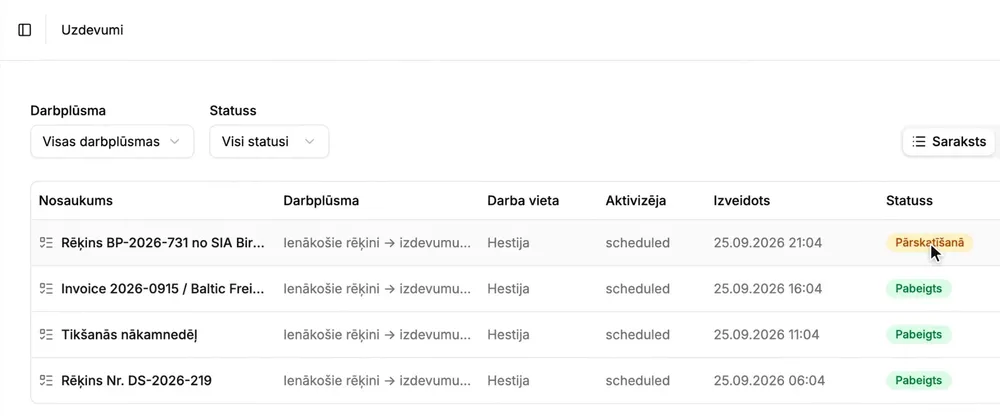
- Workflow: the mailbox is checked every 15 minutes → each invoice becomes a task → supplier, number, date, amount and VAT are extracted → the file is renamed and filed → the bookkeeper approves → anything unclear goes to a separate list
Legal and procurement: contract register and deadlines
Contracts with their end dates, renewal terms and notice periods. New partners are checked before signing.
- Contract register: end dates, renewal, notice periods with the clause cited
- Partner checks: sanctions lists and publicly available information
- Drafts of authorisations, agreements and claims from templates
- Workflow: every Monday at 8:00 → contracts and renewal clauses are read → those with notice due in 30 days are selected → a table for the lawyer → a draft notice only after approval
Three jobs we already trust Hestija with
Not a demonstration, but what happens in Mitigate's records office every month. All three end the same way: a finished document that a person reads, approves and signs.
What changed in the new version
A new version of a contract, a regulation or a policy arrives. To see what moved, somebody has to read the whole thing again - and usually nobody does.
In our own office
25 policy pages across six sites, checked on the 1st and the 15th, with a letter to the lawyer linking both versions. A person picks and signs the final wording.
Routine letters and replies
The same letters every week: a deadline reminder, a notice to the other party, an answer to a question that keeps coming back.
In our own office
Monthly invoice reminders and contract deadline notices are produced as drafts. A person sends and signs them, from their own account.
The whole correspondence by date
A case drags on for months: letters, attachments, several people. Before a meeting or a claim, someone has to assemble it all by hand.
In our own office
A disputes register with three parts - cases, chronology, deadlines. The person responsible for the case approves each entry.
Start with one process, not with a rollout project
The software is installed in a day. The real work is deciding which processes to hand over. We do that with your people.
1. Mapping
A process map
A session with management, interviews with staff and data from the systems. The result is a ranked list of processes. Optionally a reading agent on your infrastructure for a few weeks, which we then remove.
2. One process
The first result
We pick one frequently repeated process, agree what a good result looks like, connect the systems and measure.
3. Department and organisation
Shared connections
The next processes reuse the systems, knowledge and approval order already in place, so each one costs less. After the third, most teams build new processes themselves.

Control you can prove to an auditor
Records, GDPR and quality requirements are not an extra module. They are built into how Hestija works.
A person approves
Writing to a register, sending, changing a system - only after the responsible person approves. Reading needs no approval.
A full trail
Every conversation step by step: model and tool calls, time, cost. Every create, change and delete with the field-level diff. And who approved it.
Roles and departments
Workspaces per department with their own permissions. Private conversations are visible only to the person who had them.
No training on your data
Your documents and conversations are not used to train models and stay in your environment.
Cost per department
Usage and cost by workspace, workflow and user, every month.
A certified supplier
SIA Mitigate is certified to ISO 9001:2015 and applies the ISO/IEC/IEEE 90003:2018 guidelines. AI-generated text is marked.
For the administrator: how it looks
Short recordings from the platform screen. No sound, subtitles in the recording.
Setting up a workspace
Assistant name, prompt, model, members, connectors and the automatic approval policy.
An email workflow
The mailbox every 15 minutes, each email becomes a task, the register entry waits for approval.
Security and data
AI marking, roles, sharing, the workspace knowledge base and private conversations.
Usage, cost and trails
Cost by workflow, workspace and user; a trail of every step - model, tools, time, cost.
Questions IT and security ask
- Where does the data physically sit?
In Mitigate's managed cloud in the European Union, or on your own infrastructure - the choice is yours.
- Which language model is used?
You choose, and you can set a different one per department or per workflow.
- Do our documents end up in model training?
No. Your documents and conversations are not used to train models and stay in your environment.
- How does Hestija connect to our systems?
Through an API, a database or file exchange. Each user has their own connection with their own permissions, so Hestija never sees more than the employee does.
- How do we prove to an auditor what happened?
Every conversation and every action is recorded step by step: what was read, which tools were called, what changed and who approved it.
- Is the code the system runs isolated?
Yes. Code runs in an isolated environment, separately for each conversation.
Let's start with one process
Tell us which document process takes the most time in your company. We will show how Hestija would do it and agree on the mapping.
Book a mapping session