

✍️ Written by a human. Proofread by ChatGPT (because even humans need backup).
At Mitigate, we've spent the last several months working on something new - something that sits right between traditional software engineering and the brave new world of AI-assisted development.
We call it Turbo Sprint.
Yes, the name sounds a bit cheesy. Intentionally. But trust me: it describes exactly what it is. It's turbo. It's a sprint. And it's changing how we build enterprise-grade software - not "no-code" not "low-code" but real software built 10-15× faster, with up to 10× lower cost. Let me explain.
Why now? Because AI is ready - humans aren't
It's 2025, and AI is finally mature enough to reshape the entire (😈) software development process. Large language models can generate architecture, code, migrations, tests, integrations, documentation, and infrastructure scripts faster than any human team ever could. The (not so) funny part?
Engineers don't fully trust it. Businesses don't know how to work with it. Nobody has clear processes for this brave new hybrid reality. That's why we built Turbo Sprint - a structured way to let humans and AI build software together without chaos, anxiety, or accidental self-destruction. Companies that learn to work this way early will simply move faster than everyone else. They'll prototype quickly, test ideas cheaply, and take leadership positions in their industries. Everyone else? Well… let's just say "falling behind" will feel very fast (this phrase took me 30 minutes to define 🫠).
So what exactly is Turbo Sprint?
Turbo Sprint is a new methodology - and a whole engineering platform behind it - designed to let companies build serious enterprise applications with AI-generated code + human engineering expertise, side by side.
Not "toy apps". Not "weekend experiments". We're talking actual enterprise systems with:
- authentication & authorization,
- background jobs,
- file storage,
- integrations,
- dashboards,
- databases,
- APIs,
- and even built-in AI features.
Turbo Sprint is the bridge between AI and humans. It gives you the speed of AI and the reliability of real engineers.
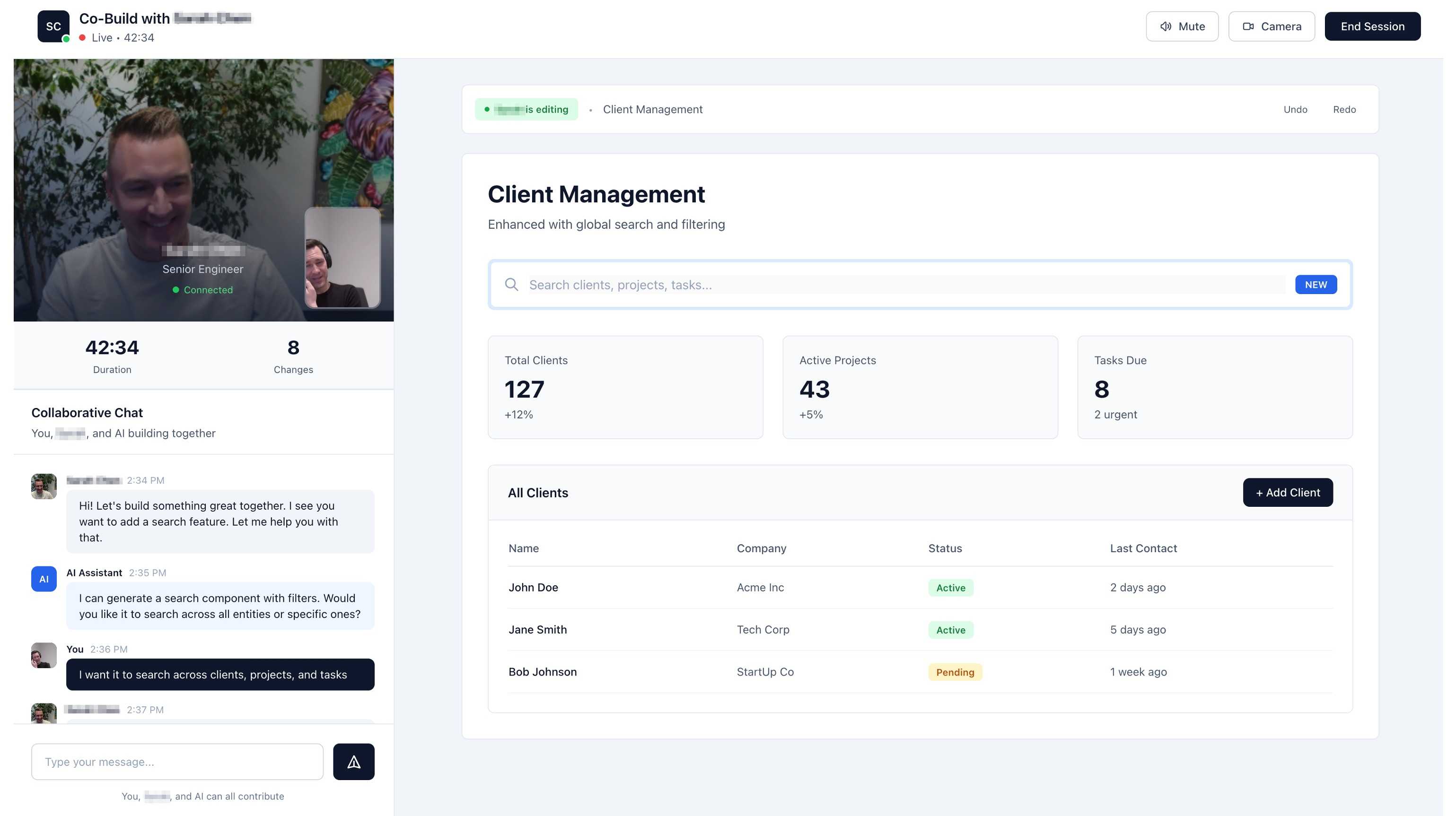
This is how it looks when a business expert co-develops with a software engineer in real-time.
Three real projects (with real clients)
(You asked for proof? Here it is.)
We've already used Turbo Sprint on three real client projects. All three companies were excited to try because it meant:
- less cost,
- faster delivery,
- clearer vision,
- and much lower risk (or lets put it this way - different risks which seem less impactful).
The results?
Even better than we expected. Working software in a fraction of the usual time. Happy clients. Kind of less stress (not sure about this yet). And yes - all three projects were fully enterprise-grade. Meaning - running in production and returning anticipated value.
But wait… isn't rapid AI coding messy?
Oh yes. Indeed, very messy. Especially for inexperienced practitioners. And this brings us to one of the most important principles we discovered.
"House Cleanup" - the big difference between prototyping and enterprise AI development
AI-generated code is great for speed. But let's be honest: it also creates technical debt at Formula 1 🏎️ pace. So, in Turbo Sprint, we have a mandatory House Cleanup phase:
- Engineers have post-session code review what was generated
- Apply a quality checklist
- Fix architecture
- Refactor overly creative AI inventions
- Stabilize the codebase
We have developed tools for the House Cleanup tasks, so it usually takes reasonable time. And if something is too big to fix right away? We write it down, transparently, for later scaling phases. This is one of the reasons Turbo Sprint works for enterprises - not just prototype hobbyists.
Geeky section (Hello, engineers 👋)
Let's talk about the real problems we had to solve to make this work.
1. Security, authentication, authorization
The hardest challenge. We needed generated apps to have secure authn/auths out of the box - no patchwork.
2. Background jobs
Enterprise systems need queues, schedulers, async tasks. We built tooling and templates so AI can plug these in automatically. Because business people usually do not distinguish between sync vs async.
3. AI inside the app (not just for building it)
Users can add their own AI features: Chatbots, analysis tools, RAG, automation workflows, etc. Of course we integrated the most common LLM APIs for AI-powered features, like "extract contract number".
4. Guardrails for non-technical users
AI can sometimes… "wander" (I carefully selected this term - wander 😂) Business people don't always define perfect prompts or requirements. We built guardrails so:
- users don't get stuck,
- the system almost never goes off-road,
- they can always roll back safely,
- and AI behaves predictably (99% 😏).
5. One-click deployment
Generated apps must be deployable with one command:
- storage
- database
- background jobs
- environment configs
- containerization
We even let users export a ready-to-run container for on-premise deployment inside their own company 🔥.
This took a lot of engineering. Worth it.
Behind the scenes: the human side
Turbo Sprint sessions are… an experience. Imagine an engineer and a business expert sitting together, building software with AI in real time. The business person is full of ideas: "This! And this! Oh, and what if we also had a feature that-"
The engineer tries to calculate complexity in their head while smiling politely.

It's a bit like preparing for a big presentation - your nerves wake up. Sometimes they misunderstand each other. Sometimes they argue a little. Sometimes they look at the same feature and imagine completely different things.
And yet…
Every time, they find a common language. Every time, there's laughter ❤️. Every time, mutual respect grows. AI accelerates the work, but human interaction is what makes Turbo Sprint magical (and occasionally hilarious).
Budgeting: the unexpected plot twist
Here's a funny truth we learned:
Many companies come with a fixed budget - let's say €3,000, which equals roughly 20 engineer co-build hours + AI expenses along the way. At first, everyone thinks: "That's plenty!" 🤦🏼♀️ Then halfway through: "Wait, how do we have only 10 hours left?!"
This forces business users to think like product managers:
- What truly matters now?
- What generates value?
- What can wait?
- What is essential for version 1?
And suddenly, they understand something engineers have known for decades:
- Every idea costs time.
- Every edge case counts.
- 👑 Prioritization is everything.
It's beautiful to watch business and engineering minds synchronize.
The future: business users building their own enterprise software
Our long-term vision?
With enough guardrails and guidance, business people will be able to build serious enterprise systems themselves, using our platform - with engineers supporting only occasionally. Not because engineers disappear. But because AI, processes, and tooling finally make it possible. Turbo Sprint is the first step toward this future.
In summary
It's not magic. It's not hype. It's simply the natural evolution of how humans and AI build software together.
AI is ready. Humans are learning. And we're building the bridge. If you walk across it early, you won't just save money or time - you'll shape the future of your industry.
This blog post is one step closer to a turning point which we think is inevitable - the way how companies develop software or outsource development WILL CHANGE FUNDAMENTALLY AND FOREVER!
Have an idea but the budget is the issue?
Get in touch with us and let's put it in Turbo mode!